
Note
Go to the end to download the full example code.
Three Point: (Non-Variational)#
The three-point bending specimen consists of a rectangular plate with a centrally located notch, supported at both ends. To enhance computational efficiency, a symmetric half-model is employed. The boundary conditions include a fixed vertical displacement over a small area (Asurface) at the lower-left support and an applied downward vertical force over an equal area at the top center. Additionally, the symmetry plane is constrained horizontally.
Note
In this case, only half part of the model is considered due to symmetry. Furthermore, a regular mesh is utilized.
#                             ||||
#                             \/\/
#            ------------------------------------*
#            |                                   |
#            |                                   |
#            |                                   |
#            |                 /\                |
#            *-----------------  ----------------*
#            /_\/_\        (0,0,0)          /_\/_\
#    |Y     ///////                         oo  oo
#    |
#    ---X
# Z /
#                             ||
#                             \/
#            ------------------* o|/
#            |                 | o|/
#            |                 | o|/
#            |               _ | o|/
#            |              a0 |
#            *-----------------*
#           /_\/_\
#    |Y     oo  oo
#    |
#    ---X
# Z /
The Young’s modulus, Poisson’s ratio, and the critical energy release rate are provided in the table Properties. Young’s modulus \(E\) and Poisson’s ratio \(\nu\) can be expressed using the Lamé parameters as: \(\lambda=\frac{E\nu}{(1+\nu)(1-2\nu)}\); \(\mu=\frac{E}{2(1+\nu)}\).
VALUE |
UNITS |
|
|---|---|---|
E |
20.8 |
kN/mm2 |
nu |
0.3 |
[-] |
Gc |
0.0005 |
kN/mm |
l |
0.03 |
mm |
Import necessary libraries#
import numpy as np
import dolfinx
import mpi4py
import petsc4py
import os
Import from phasefieldx package#
from phasefieldx.Element.Phase_Field_Fracture.Input import Input
from phasefieldx.Element.Phase_Field_Fracture.solver.solver_ener_non_variational import solve
from phasefieldx.Boundary.boundary_conditions import bc_y, bc_x, get_ds_bound_from_marker
from phasefieldx.PostProcessing.ReferenceResult import AllResults
Parameters Definition#
Data is an input object containing essential parameters for simulation setup and result storage:
E: Young’s modulus, set to 20.8 \(kN/mm^2\).
nu: Poisson’s ratio, set to 0.3.
Gc: Critical energy release rate, set to 0.0005 \(kN/mm\).
l: Length scale parameter, set to 0.03 \(mm\).
degradation: Specifies the degradation type. Options are “isotropic” or “anisotropic”.
split_energy: Controls how the energy is split; options include “no” (default), “spectral,” or “deviatoric.”
degradation_function: Specifies the degradation function; here, it is “quadratic.”
irreversibility: Not used/implemented for this solver.
save_solution_xdmf and save_solution_vtu: Specify the file formats to save displacement results. In this case, results are saved as .vtu files.
results_folder_name: Name of the folder for saving results. If it exists, it will be replaced with a new empty folder.
Data = Input(E=20.8,
             nu=0.3,
             Gc=0.0005,
             l=0.03,
             degradation="isotropic",
             split_energy="no",
             degradation_function="quadratic",
             irreversibility="no",
             fatigue=False,
             fatigue_degradation_function="no",
             fatigue_val=0.0,
             k=0.0,
             save_solution_xdmf=False,
             save_solution_vtu=True,
             results_folder_name="results_three_point_non_var")
Mesh Definition#
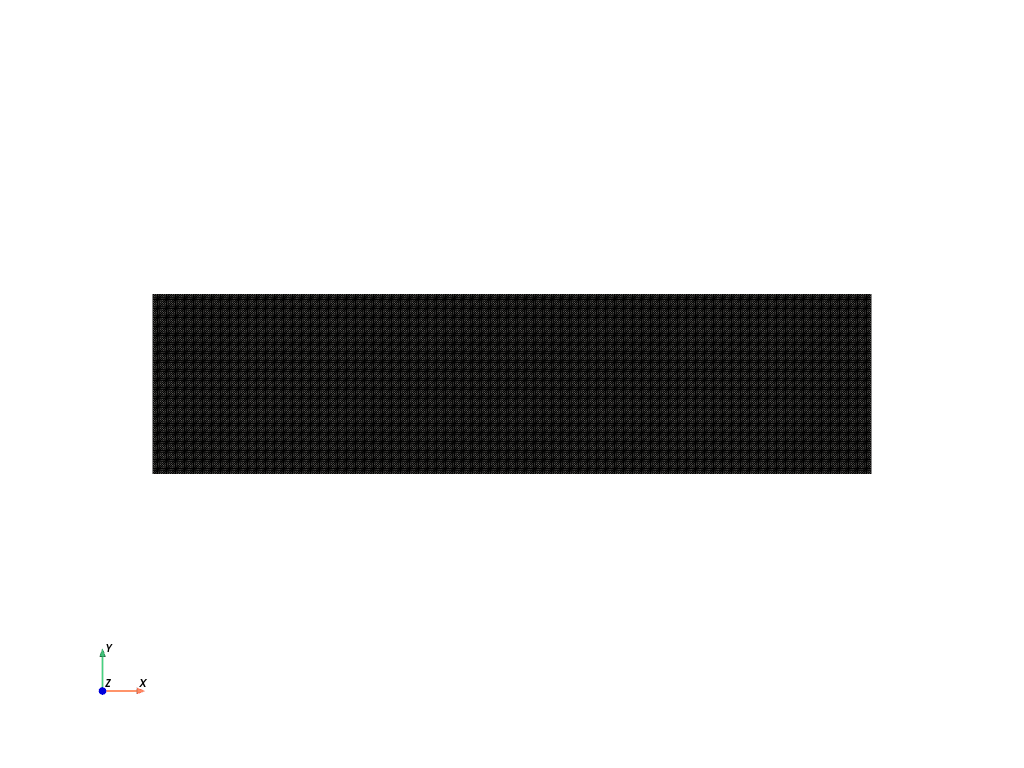
The mesh is a structured grid with quadrilateral elements:
divx, divy: Number of elements along the x and y axes.
lx, ly: Physical domain dimensions in x and y.
divx, divy = 400, 100
lx, ly = 4.0, 1.0
h = ly / divy
msh = dolfinx.mesh.create_rectangle(mpi4py.MPI.COMM_WORLD,
                                    [np.array([-lx, 0.0]),
                                     np.array([0.0, ly])],
                                    [divx, divy],
                                    cell_type=dolfinx.mesh.CellType.quadrilateral)

fdim = msh.topology.dim - 1 # Dimension of the mesh facets
The variable a0 defines the initial crack length in the mesh. This parameter is crucial for setting up the simulation, as it determines the starting point of the crack in the domain.
a0 = 0.2 # Initial crack length in the mesh
Boundary Identification Functions#
These functions identify points on the specific boundaries of the domain where boundary conditions will be applied. The bottom_left function checks if a point lies on the bottom left boundary, returning True for points where y=0 and x is less than -lx + surface, and False otherwise. Similarly, the center function identifies points on the center boundary, returning True for points where x=0 and y is greater than or equal to a0. The top function identifies points on the top boundary, returning True for points where y=ly, and x is greater than or equal to -surface, and False otherwise.
This approach ensures that boundary conditions are applied to specific parts of the mesh, which helps in defining the simulation’s physical constraints.
surface = 0.075
def bottom_left(x):
    return np.logical_and(np.isclose(x[1], 0), np.less(x[0], -lx + surface))

def center(x):
    return np.logical_and(np.isclose(x[0], 0), np.greater_equal(x[1], a0))

def top(x):
    return np.logical_and(np.isclose(x[1], ly), np.greater_equal(x[0], -surface))
Using the bottom_left, center, and top functions, we locate the facets on the respective boundaries of the mesh: - bottom_left: Identifies facets on the bottom left side of the mesh where y = 0 and x < -lx + surface. - center: Identifies facets on the center boundary where x = 0 and y >= a0. - top: Identifies facets on the top side of the mesh where y = ly and x >= -surface. The locate_entities_boundary function returns an array of facet indices representing these identified boundary entities.
bottom_left_facet_marker = dolfinx.mesh.locate_entities_boundary(msh, fdim, bottom_left)
center_facet_marker = dolfinx.mesh.locate_entities_boundary(msh, fdim, center)
top_facet_marker = dolfinx.mesh.locate_entities_boundary(msh, fdim, top)
The get_ds_bound_from_marker function generates a measure for applying boundary conditions specifically to the surface marker where the load will be applied, identified by top_facet_marker. This measure is then assigned to ds_top.
ds_top = get_ds_bound_from_marker(top_facet_marker, msh, fdim)
ds_list is an array that stores boundary condition measures along with names for each boundary, simplifying result-saving processes. Each entry in ds_list is formatted as [ds_, “name”], where ds_ represents the boundary condition measure, and “name” is a label used for saving. Here, ds_bottom and ds_top are labeled as “bottom” and “top”, respectively, to ensure clarity when saving results.
ds_list = np.array([
                   [ds_top, "top"],
                   ])
Function Space Definition#
Define function spaces for displacement and phase-field using Lagrange elements.
V_u = dolfinx.fem.functionspace(msh, ("Lagrange", 1, (msh.geometry.dim, )))
V_phi = dolfinx.fem.functionspace(msh, ("Lagrange", 1))
Boundary Conditions#
Dirichlet boundary conditions are defined as follows:
bc_bottom_left: Constrains both x and y displacements on the bottom left boundary, ensuring that the leftmost bottom edge remains fixed.
bc_bottom_right: Constrains only the vertical displacement (y-displacement) on the bottom left boundary, while allowing horizontal movement.
These boundary conditions ensure that the relevant portions of the mesh are correctly fixed or allowed to move according to the simulation requirements.
bc_bottom_left = bc_y(bottom_left_facet_marker, V_u, fdim)
bc_center = bc_x(center_facet_marker, V_u, fdim)
The bcs_list_u variable is a list that stores all boundary conditions for the displacement field \(\boldsymbol u\). This list facilitates easy management of multiple boundary conditions and can be expanded if additional conditions are needed.
bcs_list_u = [bc_bottom_left, bc_center]
bcs_list_u_names = ["bottom_left",  "center"]
External Load Definition#
Here, we define the external load to be applied to the top boundary (ds_top). T_top represents the external force applied in the y-direction.
T_top = dolfinx.fem.Constant(msh, petsc4py.PETSc.ScalarType((0.0, -1.0/surface)))
The load is added to the list of external loads, T_list_u.
T_list_u = [
           [T_top, ds_top]
           ]
f = None
Boundary Conditions for phase field
bcs_list_phi = []
Solver Call for a Phase-Field Fracture Problem#
final_gamma = 0.5
Uncomment the following lines to run the solver with the specified parameters.
c1 = 1.0
c2 = 1.0

# solve(Data,
#       msh,
#       final_gamma,
#       V_u,
#       V_phi,
#       bcs_list_u,
#       bcs_list_phi,
#       f,
#       T_list_u,
#       ds_list,
#       dtau=0.001,
#       dtau_min=1e-12,
#       dtau_max=1.0,
#       path=None,
#       bcs_list_u_names=bcs_list_u_names,
#       c1=c1,
#       c2=c2,
#       threshold_gamma_save=0.01)
Load results#
Once the simulation finishes, the results are loaded from the results folder. The AllResults class takes the folder path as an argument and stores all the results, including logs, energy, convergence, and DOF files. Note that it is possible to load results from other results folders to compare results. It is also possible to define a custom label and color to automate plot labels.
import pyvista as pv
import matplotlib.pyplot as plt

S = AllResults(Data.results_folder_name)
S.set_label('Simulation')
S.set_color('b')
Simulation quantities#
force_half        = abs(S.reaction_files['bottom_left.reaction']["Ry"])
displacement_half = abs(2*S.energy_files['total.energy']["E"]/(S.reaction_files['bottom_left.reaction']["Ry"]))
stiffness_half    = abs(S.reaction_files['bottom_left.reaction']["Ry"]/displacement_half)
compliance_half   = 1/stiffness_half
gamma_half        = S.energy_files['total.energy']["gamma"]
Plot: Phase-Field#
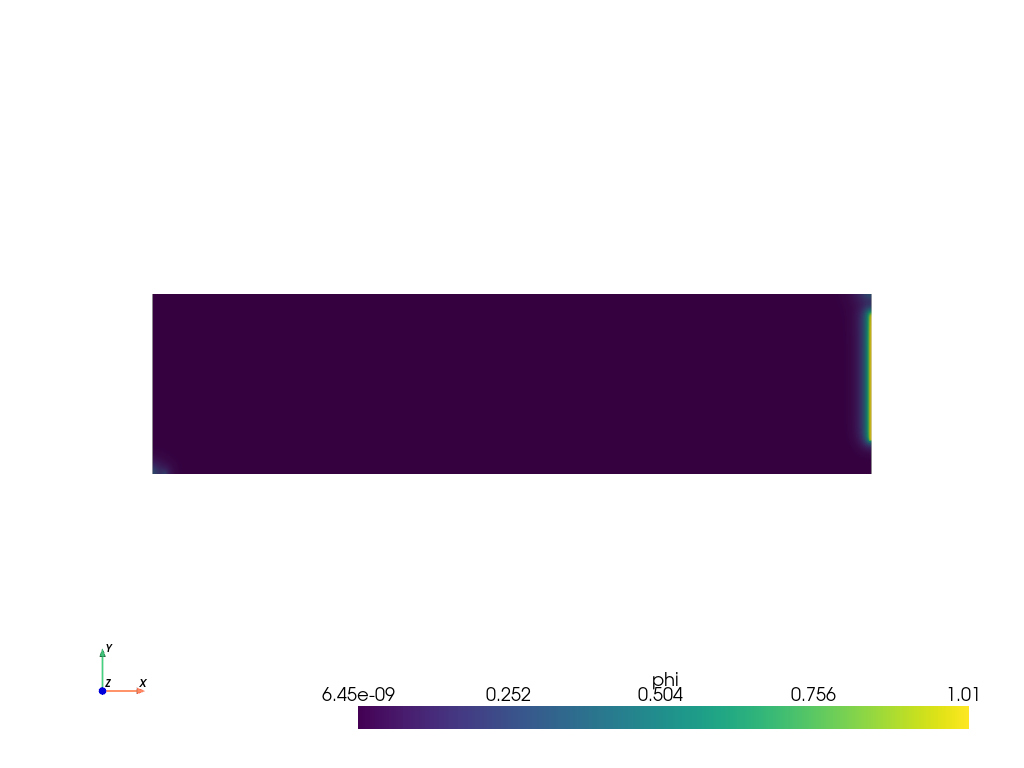
file_vtu = pv.read(os.path.join(Data.results_folder_name, "paraview-solutions_vtu", "phasefieldx_p0_000046.vtu"))
file_vtu.plot(scalars='phi', cpos='xy', show_scalar_bar=True, show_edges=False)
Plot: Mesh#
file_vtu.plot(cpos='xy', color='white', show_edges=True)
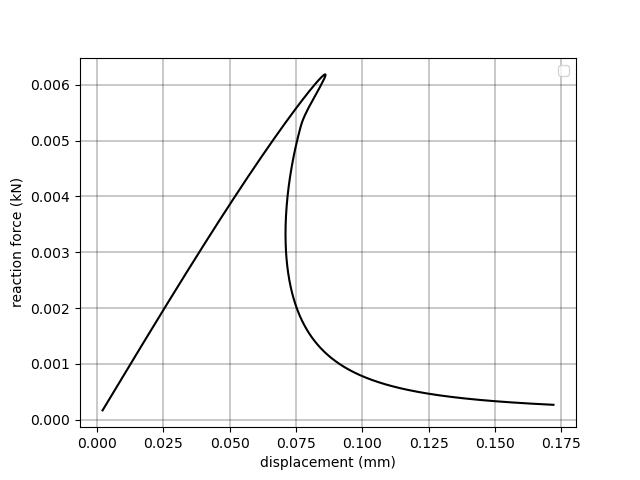
Plot: Force vs Displacement#
fig, ax_reaction = plt.subplots()

ax_reaction.plot(displacement_half, force_half, 'k-')

ax_reaction.grid(color='k', linestyle='-', linewidth=0.3)
ax_reaction.set_xlabel("displacement (mm)")
ax_reaction.set_ylabel("reaction force (kN)")
ax_reaction.legend()
/home/docs/checkouts/readthedocs.org/user_builds/phasefieldx/checkouts/stable/examples/PhaseFieldFractureEnergyControlled/plot_three_point_non_var.py:323: UserWarning: No artists with labels found to put in legend.  Note that artists whose label start with an underscore are ignored when legend() is called with no argument.
  ax_reaction.legend()

<matplotlib.legend.Legend object at 0x744320cfe110>
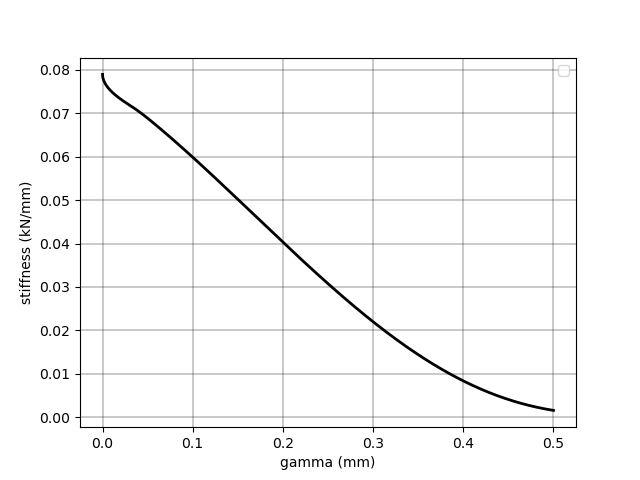
Plot: gamma vs stiffness#
fig, ax_reaction = plt.subplots()

ax_reaction.plot(gamma_half, stiffness_half, 'k-', linewidth=2.0)

ax_reaction.grid(color='k', linestyle='-', linewidth=0.3)
ax_reaction.set_xlabel("gamma (mm)")
ax_reaction.set_ylabel("stiffness (kN/mm)")
ax_reaction.legend()

plt.show()
/home/docs/checkouts/readthedocs.org/user_builds/phasefieldx/checkouts/stable/examples/PhaseFieldFractureEnergyControlled/plot_three_point_non_var.py:336: UserWarning: No artists with labels found to put in legend.  Note that artists whose label start with an underscore are ignored when legend() is called with no argument.
  ax_reaction.legend()
Total running time of the script: (0 minutes 2.157 seconds)